
 DE
DE EN
EN IT
IT SL
SL HU
HU SK
SK CS
CSLoading lift tables:
Space-saving & Safe
The perfect height compensation between truck, ramp and hall floor – efficient, compliant with standards and safe, indoors and outdoors.

Alternative to the rigid ramp: Loading lift tables are used in front of ramps or at buildings with a height difference to the yard level and are precisely adapted to the local conditions.
Safe & compliant with standards
Designed according to EN 1570-1 – with coordinated safety features.
Customizable
Platform, lift, flaps, gates, railings, signaling – suitable for the loading point.
Inside & outside
Weatherproof/corrosion-protected (e.g. galvanized) for outdoor use upon request.

Safe charging – with underrun protection and non-slip surface
For loading areas, underrun protection (e.g., bellows) and safety edges are typical components. A checker plate surface also ensures secure footing and good drive-over capability.
- Underrun protection: Bellows or PVC roller blind.
- Crash: e.g. a moving bar as a "railing".

Adapted to local conditions
For a clean process, railings/gates and (hydraulic) loading flaps are often used. Optionally, a traffic light system indicates whether the system is in operation or clear.
- Mine plan: The necessary data will be provided within the project.
- Signaling: Traffic light for status indication possible.
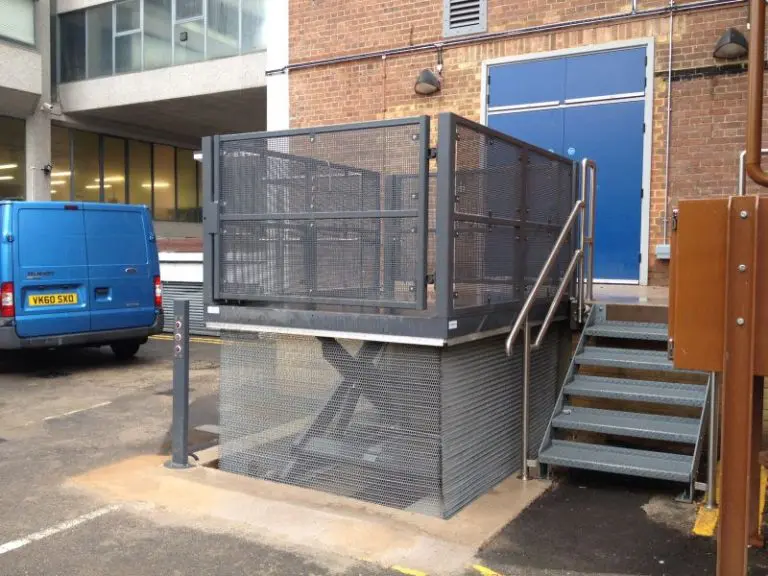
Also suitable for outdoor use – robust & protected
Loading lift tables are not only used for semi-trailer trucks/flatbed trucks, but also for leveling (e.g., lifting pallet trucks from yard level to a ramp). The safety features and operating concept are designed to suit the specific environment.
- Weatherproof: Corrosion-protected version available.
- Instructions: e.g. key switches for a limited group of users.
Comprehensive guide: Loading lift tables in detail
Dimensions, load capacities and lifting height
Common platform sizes are 2500 × 2000 mm or 3000 × 2000 mm.Typical load capacities are: 2000 kg, 4000 kg and 6000 kg.The lifting height is often around... 1300 mm (Truck level).
Drive & Exterior
Loading lift tables are usually electro-hydraulic and often run on three-phase current (e.g. 380/400 VFor outdoor areas, a corrosion-protected version (e.g., galvanizing) may be advisable.
Traversability & Safety (EN 1570-1)
- Drive-over capability: Pallet trucks/forklifts are possible – with checker plate surface and drive-over solutions (flaps/sheets).
- Underrun protection: e.g. bellows or PVC roller blind.
- Fall protection: Required for level differences of 500 mm or more (railing/bar/portal).
- Safety bar: The surrounding contact strip stops when lowering due to an obstruction.
- Signaling: Optional traffic light system (in operation/free).
More loading lift tables for viewing
If you have any questions, please contact us immediately Contact on. We are happy!


