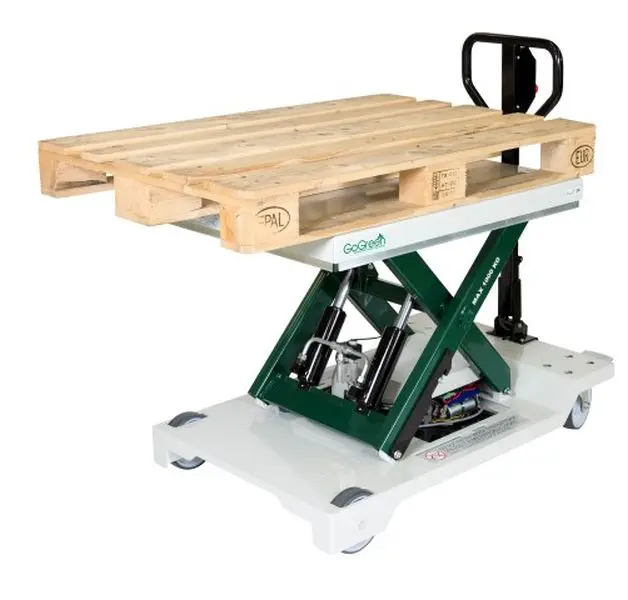
lifting table trolley

lifting table trolley

Lift table trolleys combine the advantages of pallet trucks and stationary lift tables

Lifting platform trolleys or lifting table trolleys are scissor lifting tables that are equipped with a chassis - usually wheels - as standard. These movable lifting tables are therefore mobile and not tied to one workstation.

Our lifting table trolley have a stable platform and the models have wheels that are attached to the base frame and ensure smooth running. The lifting process is carried out via a foot pedal on the manual lift table trolleys and at the push of a button on the battery-operated ones.

Lift table trolleys, also known as lifting platforms, combine the advantages of pallet trucks and stationary lifting tables. They are ideal for use where goods not only need to be lifted but also transported.

Our standard delivery program includes a variety of affordable lifting table trolleys with different load capacities. The load capacity of these lifting table trolleys ranges up to 1000 kg and the platform sizes up to 1600 x 800 mm. Many of these models are in stock and can be shipped within a very short time.
Sometimes these models are not enough, so we also offer custom-made products for these products. No matter what customer requirements, we fulfill almost every wish.

For use under high hygienic standards, a stainless steel lifting table trolley is recommended

Lift table trolley - lifting platform trolley

Electric lift table trolleys

Unlike stationary scissor lift tables, the mobile version, the lifting table trolley, also transport goods through the warehouse. The electric lifting table trolleys, also known as electric scissor lifting tables or lifting platforms, have the advantage that the goods can be lifted to the desired position at the push of a button. This saves enormous amounts of energy and time, especially with heavy loads or greater lifting heights.

Manual lift table trolleys with foot pump

These affordable lifting table trolleys, which can also serve as workshop trolleys or lifting tables, are available at short notice. We have many different models to choose from with different load capacities, platform sizes and lifting ranges. The procedure and also the lifting and lowering are manual. There is no battery or power connection.
With this mobile, affordable lifting solution, goods can be transported and lifted easily and quickly from one place to another.

Lift table trolley - lifting platform trolley

Super stable electric lift table trolley

The EZ 1001B lifting table trolley has an incredible load capacity of 1000 kg and a platform size of 900 x 800 mm. Thanks to the electric lift, you can bring your products to the desired working height at the push of a button.

Häufige Fragen zu Hubtischwagen

Worin unterscheidet sich ein Hubtischwagen von einem stationären Hubtisch?

Ein Hubtischwagen ist verfahrbar und kombiniert Heben und Transport, während stationäre Hubtische fest montiert sind. Der Wagen dient damit als mobiler Arbeitstisch und für innerbetriebliche Wege.

Welche Tragkraft brauche ich wirklich?

Ermitteln Sie Ihre Spitzenlast und planen Sie Reserven ein. Bei Teilbeladung (z. B. nur halbe Plattformlänge) muss der Wagen oft zusätzlich Reserve haben. Viele mobile Modelle decken bis ca. 1.000 kg ab; darüber wird es häufig stationär oder kundenspezifisch.

Manuell oder elektrisch – was ist sinnvoll?

Manuell: günstiger, robust, für gelegentliche Hübe kleiner bis mittlerer Lasten. Elektrisch: spart Kraft, hebt präziser und ist bei häufigen Zyklen oder höheren Lasten die bessere Wahl.

Darf ein Hubtischwagen von Personen betreten werden?

Hubtischwagen sind für Güter ausgelegt, nicht für Personen. Ob Betreten/Personenbeförderung zulässig ist, regelt die Herstellerfreigabe und die Auslegung nach EN 1570-1. Ohne explizite Freigabe: nein.

Welche Normen und Sicherheitsanforderungen gelten?

Maßgeblich ist die EN 1570-1 (DIN EN 1570-1), aktuelle Ausgabe 2024. Sie definiert u. a. konstruktive Sicherheitsanforderungen, Betriebsgrenzen und Schutzvorrichtungen.

Wie schwer lässt sich ein fahrbarer Hubtisch tatsächlich schieben?

Abhängig von Eigengewicht, Last, Radtyp und Boden. Richtig dimensionierte Räder und ebener Untergrund reduzieren die Schubkraft deutlich. Für lange Strecken oder häufige Fahrten lohnt oft ein elektrischer Antrieb.

Was passiert bei exzentrischer/teilflächiger Beladung?

Teilbeladung belastet das Scherengestell asymmetrisch; viele Anbieter fordern dann höhere Tragkraftreserven. Beispiel: 500 kg halbflächig kann einen Wagen mit 1.000 kg Nennlast erfordern.

Kann ich einen Hubtischwagen als mobilen Arbeitstisch einsetzen?

Ja, dafür werden sie häufig genutzt – für Montage, Bestückung und Transport in einem. Achten Sie auf ausreichend große Plattform, passende Hubhöhe und sichere Arretierung am Arbeitsplatz.

Ist der Betrieb auf Rampen oder unebenem Boden erlaubt?

Grundsätzlich nur auf ebenen, tragfähigen Flächen arbeiten; Schrägen erhöhen Kipp- und Rollgefahr. Maßgeblich sind die Herstellerhinweise – im Zweifel Einsatz auf Gefälle vermeiden.

Brauche ich eine ATEX-/Ex-Ausführung in explosionsgefährdeten Bereichen?

Ja, in Ex-Zonen sind nur entsprechend zertifizierte Modelle zulässig. Nutzen Sie ausschließlich Hubtischwagen mit ausgewiesener ATEX-Ausführung und Dokumentation.

Was sollte ich vor dem Kauf zusammenstellen?

Kernparameter: Traglast (inkl. Spitzen), Hubbereich, Plattformmaße, Lastverteilung, Fahrwege/Boden, Zyklen pro Schicht und gewünschte Ausstattung. Saubere Definition vermeidet Fehlkäufe und teure Nachrüstungen.

Gibt es Bereiche, in denen mobile Wagen stationären Tischen überlegen sind?

Überall dort, wo nach dem Heben auch verfahren werden soll – z. B. Montageinseln, Intralogistik, Werkzeug- und Teiletransport. Der Wagen spart Umsetzvorgänge.

en_GBEnglish