
 DE
DE EN
EN IT
IT SL
SL HU
HU SK
SKlifting table between two floors
A renowned Swiss architect approached us because he was looking for a freight elevator from the basement to the ground floor.

A renowned Swiss architect approached us because he was looking for a freight elevator from the basement to the ground floor. A conventional elevator was not an option, as the available space was insufficient for the required load capacity of 2000 kg.
We have proposed our hydraulic scissor lift table for connecting two floors. Equipped with a bolt locking mechanism at the upper landing, lateral guides across the entire lifting range, and a lift control system compliant with EN81-31, this lift table is the ideal freight elevator.
The platform size was produced at 2200 x 1300 mm. We were able to meet the requirement of a load capacity of 2000 kg distributed over the entire platform. The level difference was 3000 mm, which meant that we had to use triple scissors. The pit, i.e. the depression in the ground, had to be made 800 mm.
We not only delivered the lifting table, but also the necessary elevator doors with monitoring and locking in both stops. The assembly was carried out in one go by our technicians. As with every assembly, we provided the customer with comprehensive training and put the system into operation.
Details of the lifting table between 2 floors
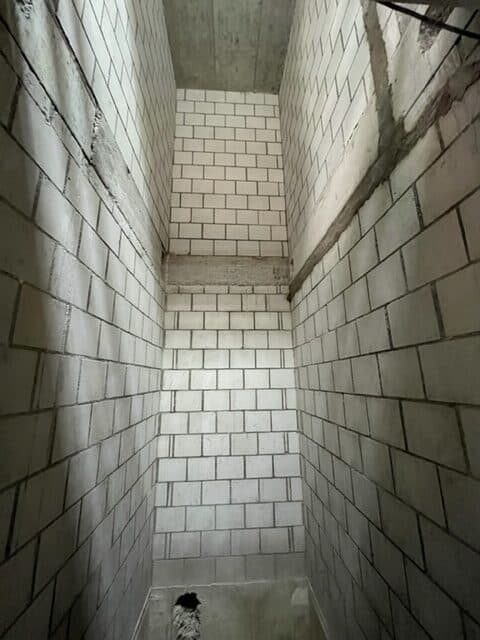
Preparation of the lifting table shaft
For all lifting tables that connect two or more floors, we create not only a system drawing, but also a shaft plan. This plan shows not only the shaft dimensions, but also the necessary empty pipes, position of the bolt lock and door clearances.
At the bottom of the picture you can see the empty pipe or the hole made for the hydraulic hose and the wiring. We lead all the cables through this hole to the location of the motor and the control system.
We can carry out a measurement of the shaft before production from the lifting table for an additional charge, but this is rarely necessary or possible in time.

Assembly with forklift
For assembly, the customer must provide us with suitable lifting equipment, in this case a forklift. Depending on the lifting equipment, we may also require an authorized driver.
In the picture, our fitter is adjusting the floor angle, which the customer has cast in concrete, so that the lifting table can then be used perfectly for transporting goods between the two levels.

Lifting table between two floors - lifting goods in the shaft from the basement to the ground floor
Here you can see the lifting table in the lower stop, in the basement. The platform of the lifting table is flush with the basement floor so that it can be loaded at ground level without a step. If the pit is not level or too deep, this height can be adjusted using the support bolts located under the platform or on the base frame.
We have installed guide rails on both long sides to prevent swaying. A corresponding recess has been prepared in the lifting table platform as a counterpart. Due to one-sided loads, the lifting table can otherwise move in one direction and drag on the wall. This prevents guidance and protects the building and the lifting table and avoids annoying noises.
We have installed a bolt lock at the upper stop. These bolts extend out of the platform and rest on a counterpart that is installed in the shaft wall. This means that the lifting table cannot sink to the upper position when it is loaded with heavy loads.
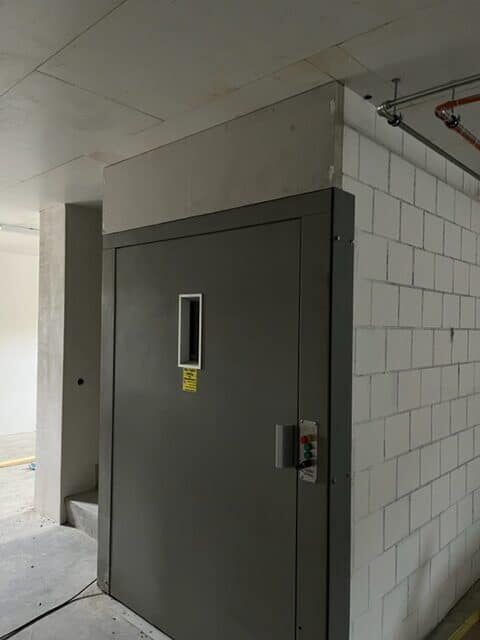
Security at both stops with elevator doors
We fitted both landings with solid elevator doors. The doors were custom-made to the customer's exact reveal dimensions to ensure a perfect fit. The doors are equipped with a locking mechanism connected to the lift platform's control system. The basement door can only be opened when the platform is in the basement. Conversely, the door at the upper landing on the ground floor only opens when the platform is in the upper position and the locking bolt is properly extended. The lift platform between the two floors also only raises and lowers when both doors are closed.
Of course, the doors can be opened separately for maintenance purposes. However, this is only permitted to trained maintenance personnel.